

Summer of Love
A pitch deck is an essential part of selling a television series; it establishes the concept, main characters, and how the creator sees the show evolving. Depending on the genre, the deck may also include information about the setting or the technology used—a mini show bible. One thing they all have in common, however, is story outlines. It might be simple loglines or more detailed synopses, but executives like to see the show’s trajectory before greenlighting it. Networks today often go beyond that, asking for potential seasonal arcs in advance.
The Sliders pitch follows the above blueprint closely; we learn a little about Quinn (loves chocolate), Wade (hippie-turned yuppie parents), Arturo (thrice divorced!), and Rembrandt (born in rural Alabama) as well as a series of unproduced ideas covered elsewhere on Earth Prime. Near the top of the document, however, is a complete outline for “Summer of Love;” it’s the only one of Tracy Tormé’s original ideas that made it to air, and it is substantially different from the finished product.
“Summer of Love” was always envisioned as the follow-up to the pilot, and even this earliest iteration involves adapting the failing timer to use the Helix spiral. One of the defining traits of the episode—the timer splitting the party in half—never happens, however, and the results lead to some surprising changes.
Tune In, Turn On, Drop Out
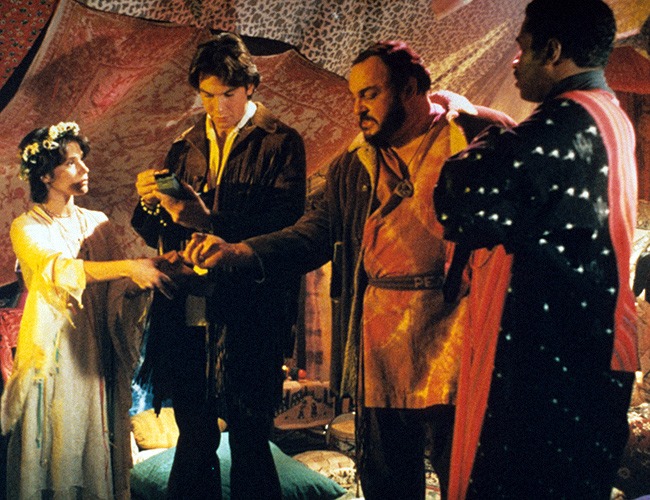
The outline begins with the Sliders exiting the vortex onto a street that “looks like Haight Ashbury in 1969.” The war between North and South Australia still exists, and society is split “between the shrinking status quo and the burgeoning Anything Goes movement.” Wade and Rembrandt don’t end up with Skidd and his entourage, and while Wade “can't help but get emotionally caught up in the spirit of urban revolution,” she doesn’t guide a group of hippies as a mystic, introduce astrology to this world, or, well… do much of anything.
Instead, the outline focuses on stabilizing the timer (still called a “gizmo”). Arturo argues that the sliding process is out of control, and convinces Quinn to combine their intellects to computer a solution to fixing the timer. “To paraphrase the professor,” the outline notes, “they must grab the tiger by the tail before it devours them.” While they rent a loft and get to work, Wade and Rembrandt go out and explore—with Rembrandt connecting with his wife and two kids.
Unlike what we saw, however, this reunion is earnest and agonizing for Rembrandt. His family is overjoyed to see him; no attention-seeking Cezanne, ball-busting wife, or gremlin son: “he feels very at home, and simply can't find a way to tell them that he is only a double from another dimension.” Over the course of several days, he strongly considers staying; ”the temptation to stay behind” is a recurring theme in the first season and one of the selling points of the series.
Eventually, Wade and Rembrandt reconvene with Quinn and the Professor at the loft. They explain that they have reconfigured the gizmo to open for one minute once per world when its weakened state can manage it. Miss that window? Stuck for 29.6 years (no, that’s not a typo). Thus the timer is born—and it’s reading two hours until the slide.
The home stretch of the episode becomes a race against time for Rembrandt, who hurries back to his family, telling the others to “leave without him if necessary.” Compounding the issue is a massive demonstration by counterculture types blocking his path (against President Bob Packwood, a Republican senator from Oregon who resigned his office rather than be expelled for, among other things, sexual harassment, sexual abuse, and assault). Rembrandt “desperately [fights] his way through the gathering antiwar crowds lining the streets,” only to learn that, as in the aired version, his double is alive and recovering in New Zealand.
Unlike what was scripted, however, Rembrandt’s wife finds this encounter a blessing: “Mrs. Brown looks at our Rembrandt in a totally different light; dazed, wondering who he is—an angel sent to comfort her—or a devil out to trick her. She instinctively leans toward the former. She thanks Rembrandt… kisses him… wishes him Godspeed. Whoever he is.”
Rembrandt makes his way back through the violence erupting on the streets, connects with the Sliders with seconds to spare, and slides. Where do they land?
“The Sliders walk down the clean city streets, instinctively feeling happy to be here. Until they spot the Bank Of America building… and the swastika above it.”
(Turn the page and you’ll see the one-pager for Twisted Cross.)
Reading the pitch, I don’t miss the spiderwasps, Bennish, the FBI, or Mrs. Tweak. I do miss all of Wade’s upbeat, optimistic, take-charge scenes in the hippie camp, though. And there’s something to be said about making Rembrandt’s journey more meaningful, even if it does eat up a huge chunk of story time.
That said, while the comedic beats of the finished “Summer of Love” are very funny, when a show like Sliders is establishing its tone, maybe consider saving the slapstick and child-choking for a mid-season adventure instead of the second episode?