

Slither
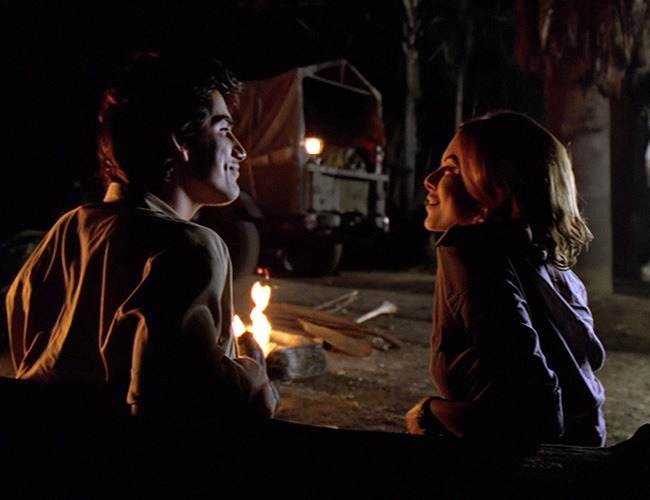
Let’s not sugarcoat things; ”Slither” is a piece of garbage conjured into existence because Kari Wuhrer had a co-starring role in the 1997 thriller Anaconda. It doesn’t deserve a deep dive into how Tony Blake and Paul Jackson wordsmithed one of the worst hours of television, mostly because almost nothing substantive changes from the February 25 Writers’ Draft to the 2nd White Revisions delivered March 11.
So why waste word count on this embarrassment to the franchise? Simple: Earth Prime got its hands on some memos from Fox and executive story editor Nan Hagan that frame the story in some enlightening ways. Curious to learn more? Read on.
Broadcast Standards
In an episode of television that involves snakes somehow knocking down a door, a man carrying a severed human hand in his fanny pack, and a dead woman clearly breathing on screen, you may ask yourself: where’s the quality control? What did the network have to say about all this?
Two memos from Fox—both dated February 28 and referencing the Production Draft linked below—break down what Broadcast Standards took umbrage with. Can a snake comically strangle an extra on screen? Sure! Can Wade stand too close to a gun? Oh, hell no (and more on that below):
- “Use a tight shot of the shoulder area when you show the knee to the groin scene.”
- “No penetration shot as Carlos jams the knife into Don.”
- “Do not depict Carlos repeating the stabbing action as it plays too extremely.”
- “There must be no actual physical contact between Wade’s head and the barrel of Carlos’ derringer.”
In addition to censoring obvious hardcore violence, Standards has something to say about the language Blake and Jackson serve up—especially when it comes out of Rembrandt’s mouth:
As previously noted, this episode has entirely too many usages of Damns & Hells. Please reduce them significantly. They can be found on pages: 8 (Hell), 12 (Damn it & hell), 13 (damn), 20 (Damn), 22 (hell), 30 (hell), 32 (hell), 41 (damn), 42 (damn), 46 (hell twice), 50 (damn). Of the thirteen uses, ten are spoken by Rembrandt. Because Rembrandt is our only African-American character, his casual profanity MUST be deduced by five mentions as not to give the impression that he is more apt to curse than anyone else.
The second memo echoes some of the complaints above, but also adds to the insanity with these gems:
- “Ensure that there are no commercially identifiable airlines visible at the Zamara Terminal and at San Francisco International Airport. All commercial planes and terminals must be generic or fictitious.”
- “Clear ‘Xentech’ as fictitious.” (It may not have, since the last revision we have access to has changed Kyra’s company name to Selvatech.)
- “Ensure the store and the bottled water are generic or fictitious.”
- “The label on the aspirin bottle should be generic or fictitious.”
- “Exercise caution when Maggie strips down, yet again, that her underwear provides sufficient coverage. May I suggest a fabric other than cotton as cotton underwear tends to hug and reveal when wet.” (Thanks, we know how water works.)
- “Exercise caution that it doesn't appear overly graphic when Quinn pins the snake to the floor with the knife.”
- “Find some other action than having Carlos backhand Kyra with the gun. This type of assault toward women is violent and plays much too extremely.”
Behind the Scenes
Can you imagine anything worse than having to write a memo to a production company telling them to tone down assault? How about being on staff and coming up with six pages of story notes that outline in excruciating detail just how bad Wade and Maggie were written in this episode?
Nan Hagan goes over this mess with a fine-toothed comb, outlining repetitious, inconsequential, and contradictory dialogue. In a brief scene early on where Maggie ogles Carlos (“he’s hot”), Nan tries to reframe the conversation to where Wade and Maggie connect over something, anything:
This kind of a set up would actually get them for a minute on something all girls connect—a good looking guy! At least give them a moment of friendship.
The memo allows fans to read the production poking holes in its own half-assed logic:
- “So it's what, two or three in the morning? Why are they up? What has Wade been doing while Maggie and Carlos are flirting by the fire?”
- “Why does she even care if Maggie and Carlos are flirting with disaster? Why does she behave like the mother superior of a convent?”
- “Why does Wade try to call the U.S. Embassy from a village in the middle of drug country?”
It’d be comical if it wasn’t so sad; Hagan is clearly trying to get the women to act like human beings and not just mannequins that move the plot forward (while wearing whatever won’t set Broadcast Standards on fire). “I know you're trying to stir something up here between the girls,” she writes, “but it feels a bit like bickering for bickering's sake. We already get that there's tension between them and we don't really need the swipe of sweet and docile.”
But the best comment comes right at the very end. Don’t mistake its brevity for a lack of impact:
- Pages 46-51: Wade is present for 6 pages and doesn't have one line.
What else needs be said?