

The Young and the Relentless
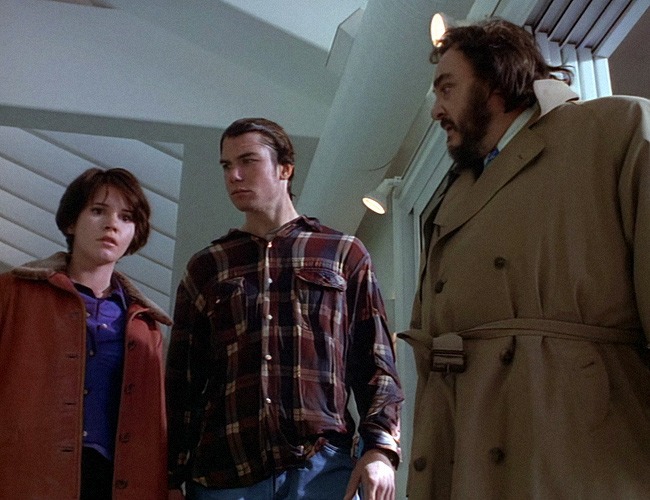
Writers T. Edward Anthony and his partner Von Whisenhant made not only their Sliders debut in 1996, but “The Young and the Relentless” was the first script of theirs to ever be produced! And then they never wrote another thing. Spooky, no?
The answer is more prosaic; writing team Tony Blake and Paul Jackson took their name off the episode over a credit dispute involving Michael X Ferraro's participation in the story process. This is the only script in Sliders history where an author has rage quit their own script—an amazing feat considering we live in a world where “Slither”, “The Chasm,” and “Paradise Lost” also exist. What changed that was so offensive? Fortunately, we have a dozen drafts to examine, dating all the way back to the Writer’s Draft. Let’s dive in!
Writer’s Draft
“The Young and the Relentless” is best known for Sabrina Lloyd’s powerhouse performance of this world’s Wade Welles, a cunning, power hungry entrepreneur whose ambition knows no limits. Presumably, this entire episode was conceived to give Lloyd this opportunity. That presumption is wrong. The Writers' Draft (with Blake and Jackson credited) has a guest star playing QR’s vicious wife, Alisha.
Why would Quinn care about Alisha? Because on his world, Alisha died tragically in his arms at summer camp when he was sixteen. (Quinn doesn’t strike me as a summer camp kid.) Once again, Quinn is the chump for the lady, even though Alisha is even more awful than alt-Wade. No need for Kyle Beck to steal the timer and blackmail the group; Alisha does it herself. So by the start of Act 2, Quinn is under no illusions about who Alisha is: “Wow. A blackmailer AND a thief.”
The backstory of this world is pretty simple. Corporations marketed so intensely to the youth that the youth realized they were a powerful economic block. They turned that into political power. Once they gained control, they re-wrote all the rules. No timetable is provided for the takeover, no explanation given for how there were enough 18-30 year olds to outvote the 30+ population. But it’s enough for Arturo to blame the state of affairs on “the almighty dollar.”
The story is primarily the same with Quinn (and Wade) learning what scumbags QR and Alisha are, with Arturo and Rembrandt on the run from the law. Some scenes, such as Arturo’s first courtroom appearance, have yet to materialize; others get replaced. In the finished product, Melanie White accosts Quinn directly over the death of her husband; here, Quinn pays her a visit on Death Row. The corporate intrigue is different, perhaps even more coherent than what eventually made it to air, but not truly consequential.
What is more pronounced is the grim state of affairs for the over 30. The journey the Professor and the Cryin' Man take still has its humorous moments, but there are darker undertones. The interactions they have with the people in the shelter tell tales of horror for a world with no jobs and no safety nets. Rembrandt tries to use the restroom only to discover a man has hung himself.
The big challenge is the resolution. Our Wade can’t simply impersonate Alisha and confess to all her crimes. So our crew doesn’t have Alisha dead to rights. All they can do is threaten, and fortunately, she takes the bait. That said, Alisha is a really terrible criminal. She keeps evidence of her murders, talks about her crimes in surveilled areas, and believes the solution to all of her problems is just a little more murder.
Production Draft and Revisions
That’s all for Alisha. Enter alternate Wade in the Production Draft.
At this point, it’s a process of iteration; switching Alisha to Wade gives Quinn a lot more incentives, and making Kyle Beck the heavy allows Wade 2 the opportunity to work Quinn deeper into the script. A subplot where Kenny Hatcher is secretly overage is dropped and he’s just the guy who figures out Quinn is a fraud, but it takes a while to get rid of a dead-end plot involving him and QR’s mistress Margo. The wreckage of this plotline isn’t completely excised in the final product, as Hatcher plays no role in the finale.
A security guard—later named Gillette—is added to give Wade 2 an enforcer inside the house to handle a now house-arrested Wade. The subplot with the woman on Death Row is simplified so she’s just a woman seeking justice. Is she even necessary at this point? Unclear, but she still gets her scene.
Jimmy Carter gets to lay claim to the title of history’s greatest monster when he abdicates to his 13-year-old daughter Amy in 1980. It still doesn’t make a lick of practical sense, but throw in some cover about a bankrupt social security program, and off we go.
Arturo and Rembrandt’s journey rounds into form in the production draft, getting very close to the final scene. Bit by bit, their excursion to the shelter is trimmed back to basically nothing.
Judging from the rapid succession of drafts, this episode absolutely turned into a grind. But when did it cause the writers to pull their names off?
Gillette’s True Master
Maybe it was the coda that had Gillette report back to the Kromaggs? Even though we know that's not the case, it's the story we're sticking with.
Production Archive
- March 12, 1996: Writers' Draft
- March 15, 1996: Production Draft
- March 18, 1996: 1st Pink Revisions
- March 18, 1996: 1st Blue Revisions
- March 19, 1996: 1st Yellow Revisions
- March 20, 1996: 1st Green Revisions
- March 20, 1996: 2nd White Revisions
- March 22, 1996: 2nd Blue Revisions
- March 25, 1996: 2nd Yellow Revisions
- March 27, 1996: 3rd White Revisions