

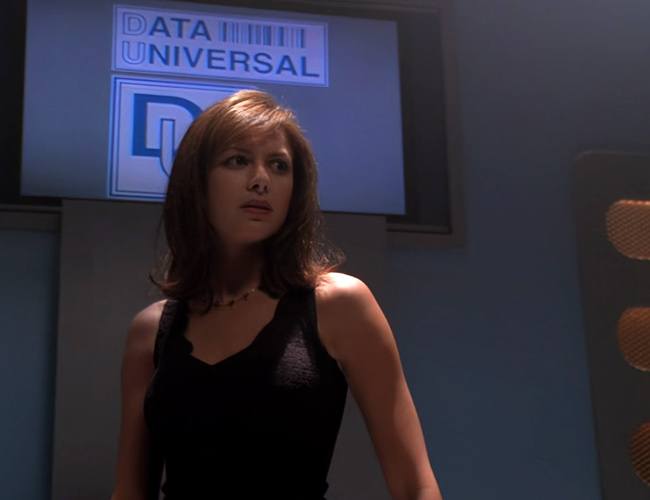
Throughout the years, Sliders has contemplated many what-if scenarios, but it has generally avoided being self-referential. In this week’s episode, however, the producers dare ask the question: what if we have to make a full episode without a budget?
“Please Press One” is the cheapest episode of Sliders we’ve yet seen. Wait. That’s unfair. I have no idea what the actual budget of this show was, so allow me to rephrase: "Please Press One" is the cheapest looking episode of Sliders we’ve yet seen. It boasts all of two locations—outside (a barely redressed Courthouse Square at Universal Studios) and inside (a barely decorated—and barely lit—building, which if you told me were the show’s actual offices, I’d believe you). There are a grand total of four speaking characters amid extras few and far between. And yet, the cheapest element deserves its own section. Let’s hold off on that and get to the story, though. I’ll be brief, because there isn’t much of one.
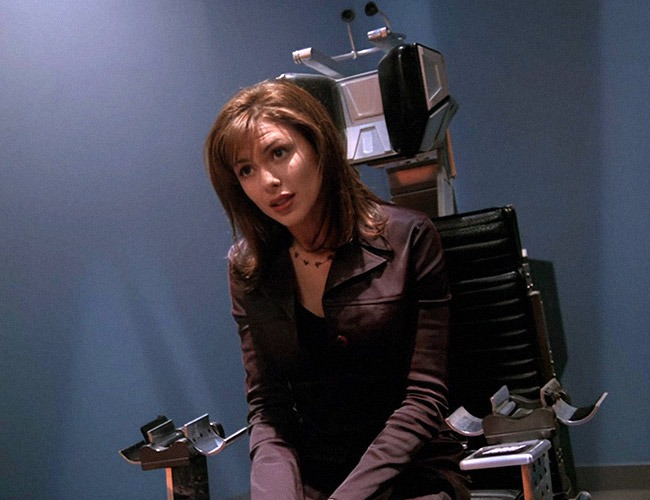
Clearly inspired by frustration with automated call centers, “Please Press One” takes that trend to its logical extreme. Here, everything is automated; no human interaction is required for anything. Just wave your wristband in front of what you want and it will be dispensed! In some instances, you don’t even have to ask as needs are anticipated based on your profile. So, I tip my hat to you, William Bigelow—you pretty much predicted Amazon with Data Universal, a company so great it succeeds despite being called Data Universal.
This concept is then fit into Sliders Formula #1: one of the team runs afoul of the world and is captured while the others have to work to reunite before the slide. Maggie is this week’s designated victim as the intelligence office pretty much just stands there as she’s grabbed off the street. Once inside, she must navigate the corporate bureaucracy. Unfortunately, corporate bureaucracy isn’t much more exciting in this world than it is anywhere else.

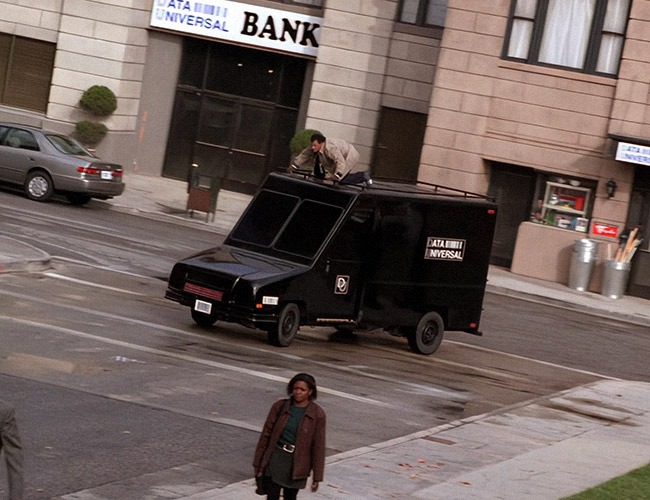
The other three have far less to do on the outside. Unable to get anyone to talk to them, let alone help, they end up getting the attention of Arlo (J.D. Cullum). Arlo is a mess of contradictions; his filthy rags and unkempt appearance imply homelessness, but he does have a home. It also turns out he’s a successful identity forger and could live like a king, except it never seems to occur to him. He used to work for Data Universal and must know exactly where it is, but he does not take the Sliders there, instead relying on a nutty scheme to hijack an automated delivery truck. If I take Arlo at face value, I can only conclude he is mentally ill. Occam’s Razor, however, tells me he’s just very poorly written.

Unfortunately, that’s a trend in this episode. Not much makes sense—and not merely upon reflection. It doesn’t make sense in real time. Maggie is abducted because she presses a button for service and Data Universal doesn’t know what to do with her. But we later learn her double does exist and the scan should have reflected that. Data Universal then tries to process her as if she’s a new customer. But in this world, there are no new customers. No grown adult would be outside the system. This is brought home by James (Reno Wilson), a self-described Refuser. Because James refuses to comply, he's forced into a subsistence life at Data Universal's headquarters. But he’s hard to explain, too; James has no real interest in leaving and is treated like any other customer of Data Universal – just one too lazy to get a job.
At one point, Maggie is sent for "deletion." But deletion is never spelled out. We already know Data Universal doesn’t kill useless people—James is proof of that. For all we know, deletion is merely being led to the exit to fend for oneself on the street. Because if murder is truly on their minds, they wouldn’t escort their prisoners to the death chamber with a Roomba.
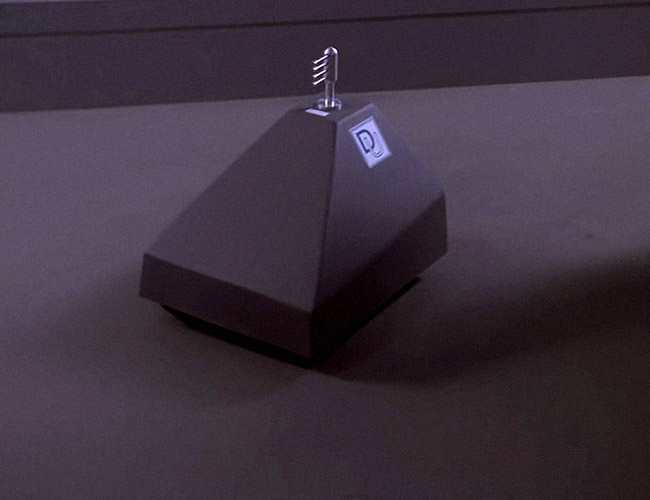
Now here’s where we get back to the cheapest episode ever. Clearly, the script intended something menacing—probably a machine that filled the hallways. But what they got was that little skittering robot Chewbacca intimidates in Star Wars. Maggie doesn’t need a bomb to defeat it; she can simply kick it over! Whatever they had planned has clearly failed, but do they change gears and try something else? Use a human with a gun to escort Maggie? Or a human pretending to be an android? No. They stuck with the Roomba. I almost have to applaud that commitment to absurdity. If nothing else, it takes guts to give SciFi that big a middle finger: “You get what you pay for, and this is what you paid for.”
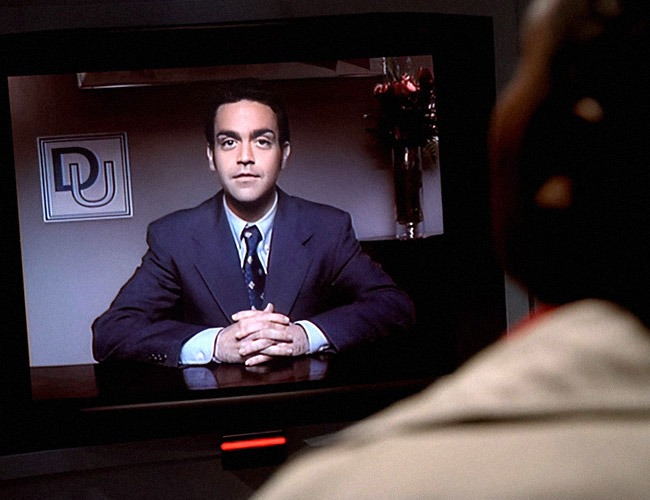
There are a few somewhat redeeming qualities to this adventure. While I can’t say it came as a shock that Maggie’s customer service rep (Maury Ginsburg) was an artificial intelligence, it was still another win by Bigelow at predicting the future. It took a few more decades for this to get really out of hand, but some 20+ years later there are a lot of Arlos who have been replaced by AI. I also like the irony that there is such little personal touch in this America that even the AI reacts positively to Maggie’s overtures of friendship, even if she’s just using it for her own ends.
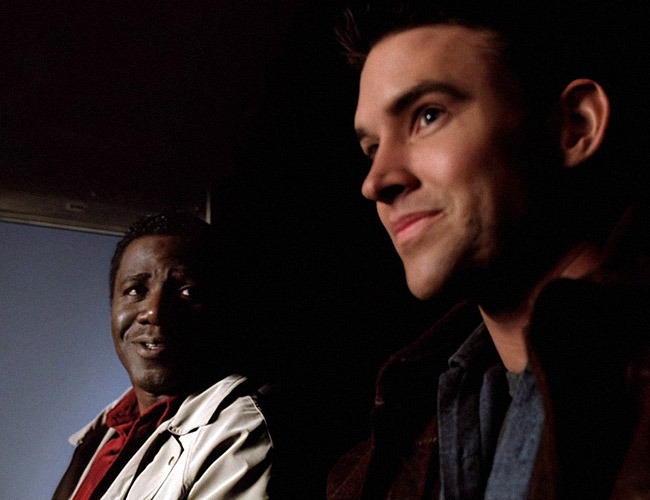
And, if I’m awarding points for trying, I was pleased Maggie was able to use the quirks of this world to make her escape. Data Universal is so eager to serve—and so negligent in its safeguards—that it delivers Maggie the materials she needed to build a bomb and blow up her detention chamber. The Sliders also ultimately subvert Formula #1 by choosing not to burn Data Universal to the ground and upending the world order. They rightly deemed that would do more harm than good—and they sure didn’t have the budget to pull it off.