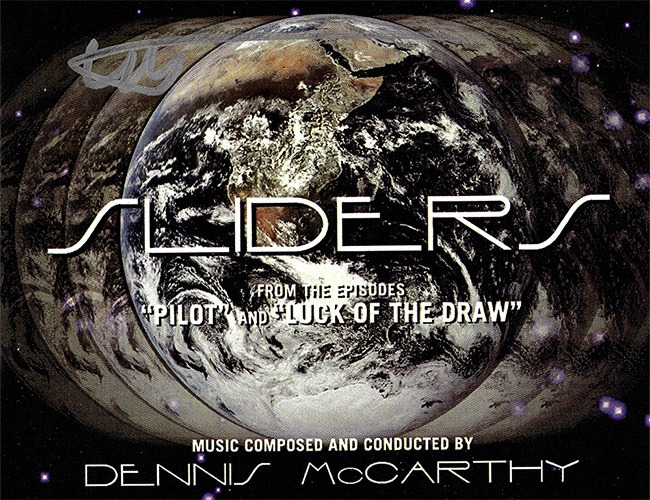
Sliders was a science fiction adventure series about four explorers who discover a gateway to traveling to parallel universes. It asked the perennial question “what if” and chronicled the adventures of pioneers who have figured out how to “slide” through parallel dimensions, experiencing and exploring Earth today as it would be if a different path had been taken, personally or historically. So though it’s always Earth today, the group encountered different “what if” scenarios each time they visited a parallel dimension.
The eclectic group of Sliders included: Quinn Mallory (Jerry O’Connell)—a young genius who finds the key to “sliding” in a homemade laboratory; Professor Maximilian Arturo (John Rhys-Davies)—Quinn’s traditional professor who reluctantly goes along for the scientific ride of his life; Wade Welles (Sabrina Lloyd)—Quinn’s good friend whose unrequited love is a source of tension between them; and Rembrandt “Crying Man” Brown (Cleavant Derricks)—a member of the classic singing group “The Spinning Topps” who is known for crying real tears at every performance and is unwittingly caught in the momentum of the initial “slide.”
Two episodes of the series—the pilot episode and “Luck Of the Draw”—were scored by long-time Star Trek composer Dennis McCarthy. One of the most in-demand composers for films and television, McCarthy has spent his life in and around music. Growing up, in North Hollywood, California, McCarthy played violin and piano. He studied Engineering and Physics at Northridge and UCLA while supporting himself by playing weddings and frat parties on the weekends. Eventually Dennis joined the ranks of the “Surf and Car” groups and began a new career as a keyboardist in the studios. One of the musicians he met in those years was Glen Campbell, when he was a session guitarist. When Glen became a star and recorded “Gentle On My Mind” and “By The Time I Get To Phoenix” he asked Dennis to join him as a keyboardist. As Glen’s fame grew, he needed an ‘on the road’ arranger/conductor and McCarthy took on the challenge of a musical self-education and the mentoring of many wonderful
musician/arrangers.
The association with Campbell, who was at the peak of his popularity in the late 1960s as a crossover singer hitting it high on both the country and pop charts, led to McCarthy’s first television work, acting as the musical director on the long running “Glen Campbell Goodtime Hour” variety show. Dennis also served as musical director for three seasons of “The Barbara Mandrell Show.” He went on to become Alex North’s scoring assistant, working with the great composer on many of his finest works, including orchestrating North’s score to “Wise Blood,” before McCarthy embarked on his own composing career in the early 1980s.
One of the first people McCarthy met during his stint as a road musician was Marty Paich, a television music director who first recognized McCarthy’s musical abilities. Nelson Riddle became another source of inspiration; it was Nelson who suggested McCarthy spend more time composing and arranging rather than playing the piano on the TV show.
McCarthy spent four years on “Glen Campbell Goodtime Hour,” working and learning from Marty Paich as well as Ray Charles, who was the show’s choral director, and also Earl Brown who also worked on the show. An opportunity to compose a film score in England opened doors for McCarthy when he returned to Hollywood, giving him experience in orchestral writing while also giving him a feature film credit that created new opportunities in Hollywood. One of them led to “Enos,” a spin-off of “The Dukes of Hazzard,” which McCarthy began to compose in 1981. A fistful of TV scores for Warner Bros followed included “V: The Final Battle,” the new incarnation of “The Twilight Zone,” “Dynasty,” “MacGyver,” and a few movies-of-the-week like “Sam Houston: The Legend Of Texas” and “Sworn To Silence.” With George Doering, McCarthy flexed his blues muscles and composed the music for a series called “Houston Knights,” which led to an assignment scoring the first of the two-hour “Police Story” shows.
McCarthy found himself basking in public prominence when he was hired as one of the regular composers on “Star Trek: The Next Generation” in 1987, and since then has contributed music to all the subsequent Star Trek series, including scoring the seventh Star Trek movie, “Generations” in 1994. McCarthy’s musical versatility hasn’t stayed still for episodic television, however – he has scored a number of feature films and made-for-TV movies, including “Overkill: The Aileen Wuornos Story” (1992), “McHale’s Navy” (1997),”Letters from a Killer” (1998), and several mini-series based on the popular novels by Danielle Steele.
McCarthy is a seven-time Emmy nominee, and won the award in 1993 for his work writing the main title to “Deep Space Nine” and again in 1996 for the score to the episode, “Unification, Part 1” from “Star Trek: the Next Generation.” He also recently jumped into theatre work for South Coast Repertory in Costa Mesa, CA, composing the music for “Of Mice And Men,” “Much Ado About Nothing,” “On The Jump,” “The Dumb Show,” “Dicken’s Christmas Carol,” “The Beard Of Avon” – the premier of the Amy Freed play, “Getting Frankie Married, and Afterwards” a play by Horton Foote which also premiered at the SCR. Among his most recent projects, Dennis scored the TV sitcom “Related,” for Warner Bros Television.